Science Pool

AAPS PharmSci360 2023

Posted by Evotec on Sep 12, 2023 12:48:56 PM

Date: 22nd - 25th October 2023

Location: Orange County Convention Center - Orlando, FL

Orlando_AdobeStock_617622107_rsz-1

Our team at AAPS PharmSci360

  • Claudio Marcello Marzo, Associate Scientist • In Vivo Safety
  • Pascale Clement, VP Pharmaceutical Development Science & Strategy • Pharmaceutical Development & Manufacturing
  • Piero Piccinni, Senior Supervisor • Drug Product Manufacturing Operations
  • Dhimant Patel, Senior Director • Business Development
  • Michael Campognone, Senior Director • Business Development

Evotec will be exhibiting at booth #2935


View our AAPS PharmSci360 scientific presentations. Request your personal copy!

You will receive our four posters and two Rapid Fire presentations in your inbox right after the event. 

Our fully integrated solutions

Our CMC solutions are enhanced by the seamless integration of expertise and capabilities spanning from target identification to clinical development, including early and regulated ADME-Tox and safety pharmacology, regulatory support, clinical development & translational medicine:

  • Drug Substance & Drug Product Development from Lab Scale to Commercial Manufacturing
  • GMP Manufacturing of Small Molecules, Biologics, Cell Therapy Products
  • Early and Regulated ADME-Tox and Safety Pharmacology
  • Full Regulatory Support, Clinical Development & Translational Medicine (Phase 1/1b)

Meet us at booth #2935


Learn more about Evotec at CPhI Barcelona and AAPS PharmSci360 2023

Tags: Events, Evotec

iPSC-Derived Cell Therapies Summit 2023

Posted by Evotec on Sep 12, 2023 11:35:30 AM

Date: 3rd - 4th October 2023

Location: Boston, MA, United States

Attending: Audrey Holtzinger, Vice President iPSC Cell Therapy, and Olivia Candini, Cell Therapy Process Development Supervisor

Evotec is Innovation Partner at this event. 


Oral and poster presentation


Diabetes cell therapy with Evotec iPSC-derived islet-like clusters in the Sernova Cell PouchTM

Presented by Audrey Holtzinger, Vice President iPSC Cell Therapy, Evotec

  • Update on Evotec’s end-to-end integrated platform for iPSC-based cell therapeutics
  • Results from pre-clinical testing of iPSC-derived islet-like clusters combined with the implantable Cell Pouch
Oral presentation date and time: October 4th, 2023, 2:30pm local

Session: The Future is iPSCs: Re-Evaluating Translational & Strategical Priorities to Drive Next Steps Across the iPSC Industry


Development of an off-the-shelf allogenic anti-cancer cell therapy using potent iPSC-derived natural killer cells

Presented by Audrey Holtzinger, Vice President iPSC Cell Therapy, Evotec

Poster presentation date and time: October 3rd, 2023, 3:00pm local


Learn more about the iPSC-Derived Cell Therapies Summit 2023

Tags: Events, Evotec

How an Integrated, Continuous, Intensified Approach for Manufacturing Biologics Provides Productivity and Quality Benefits

Posted by Evotec on Aug 29, 2023 6:31:11 PM

Tags: Articles & Whitepapers, Biologics

Why early mAb Sequence Optimization can Improve Developability and Reduce Costs

Posted by Evotec on Aug 29, 2023 6:27:55 PM

Tags: Articles & Whitepapers, Biologics

Reducing biopharmaceutical manufacturing costs through continuous processing

Posted by Evotec on Aug 29, 2023 6:17:11 PM

We recently published our latest paper in Drug Discovery Today. Our authors Fernando Garcia and Eva Gefroh introduce a type of flexible biomanufacturing facility called J.POD®, capable of capitalizing on Intensified Continuous Biomanufacturing (ICB) to deliver against current cost and speed needs in the biopharmaceutical industry. We are pleased to share this featured review with industry and partners as we continue to work together to expand access to medicines that matter.

Abstract

In this work, process models were developed to capture the impact of biomanufacturing costs on a commercial scale and emphasize the way in which facility design and operation must balance meeting product demand while minimizing production costs. Using a scenario-based modeling approach, several facility design strategies were evaluated, including a traditional large stainless-steel facility and a small footprint, portable-on-demand (POD)-based facility. Bioprocessing platforms were compared by estimating their total production costs across different facility types and specifically illustrating how continuous bioprocessing has gained in popularity as a novel and cost-effective approach to manufacture high-quality biopharmaceuticals. The analysis showed how fluctuations in market demand have a dramatic effect on manufacturing costs and plant utilization, with far-reaching implications on the total cost to patients. Read the full article in Drug Discovery Today.

READ NOW

Tags: Articles & Whitepapers, Biologics

Inhibition of METTL3 results in a cell-intrinsic interferon response that enhances anti-tumour immunity

Posted by Evotec on Aug 29, 2023 8:52:27 AM

A major disadvantage in fighting cancer is the low immunogenicity of cancer cells, impairing body’s ability to identify and destroy them. This paper describes STM3006, a novel, chemically distinct inhibitor of METTL3 with improved biochemical and cellular potency compared to the previously published ligand STM2457. Crystallography revealed improved binding within a newly formed ligand-induced lipophilic pocket within the protein, while retaining the interactions that provide high selectivity over other methyltransferases.

The authors demonstrated that METTL3 inhibition with STM3006 stimulates a cell-intrinsic interferon response through double-stranded RNA formation. This immunomodulatory mechanism is distinct from current immunotherapeutic agents and provides the molecular rationale for combination with anti-PD1 immune checkpoint blockade to augment anti-tumour immunity. In combination these therapies have demonstrated the ability to overcome malignant clones insensitive to the single agents. 

This article is written in collaboration with Storm Therapeutics.

READ NOW

Tags: Articles & Whitepapers

57th Congress of the European Societies of Toxicology - EuroTox

Posted by Evotec on Aug 24, 2023 1:49:27 PM

Date: 10th -13th September 2023

Location: GR - Ljubljana Exhibition and Convention Centre, Ljubljana Slovenia

Booth Location: 59

Attending: Ben Park, Alessandro Casartelli, Oksana Nikolayenko, Daniel Gliesche, Martin Augustin, Giuseppe D'Angelo & Rob Brown

Presentations

“Genotoxicity Risk Assessment during Lead Optimization Phase in Pharmaceutical Drug Development” - Presented by Alessandro Casartelli 

"Detection of Chemical Reactive Metabolites in a Glutathione depleted in vitro system" - Presented by Ben Park 

Download: Bioactivation Driven Toxicity Product Sheet

Learn more about EuroTox 2023

Tags: Events, Evotec, Cyprotex

QUOD & Evotec: An academia-industry partnership built on complementary strengths

Posted by Evotec on Aug 22, 2023 12:02:39 PM

Organ transplantation is often the only available treatment option for patients suffering from end-stage kidney, liver or heart disease. In collaboration with the QUOD initiative, Evotec is committed to improving the quality of organ donation and transplantation and advancing the mechanistic understanding of these common diseases. Through multimodal characterization of donor biopsy transcriptomes and associated clinical data, our scientists aim to identify early disease signatures and targetable mechanisms of injury and repair that will open new avenues for therapeutic intervention and patient stratification. For more information, please read the recent QUOD newsletter article.

READ NOW

Tags: Articles & Whitepapers

Blood microsampling in cynomolgus monkey and evaluation of plasma PK parameters in comparison to conventional sampling

Posted by Evotec on Aug 22, 2023 11:57:37 AM

Blood microsampling is a less invasive and simplified alternative to traditional venipuncture for PK/TK sampling, used mainly in small-animal studies. The purpose of this work was to evaluate the possibility of using microsampling technique also to support PK/TK studies in non-human primates.
A comparison of plasma PK parameters was conducted by traditional blood collection from the femoral vein and microsampling from the tail vein of six non-naïve cynomolgus monkeys. Four drugs were selected for this comparison, based on acid-base properties and volume of distribution. 
The results obtained in this work, supported by robust statistics, demonstrated the suitability of microsampling in supporting PK/TK studies in non-human primates. 
The plasma exposures of the tested drugs are comparable for both sampling techniques and are not influenced by acid-base characteristics and volume of distribution. 
Microsampling used in non-human primates avoids the occurrence of hematomas at the animal sampling site and can also refine practices to limit pain and distress to which animals are exposed (refinement of 3Rs) and, as a result, may reduce the impact of animal stress on PK/TK readouts; moreover, it also provides significant advantages for animal technicians during in life handling.

To request a copy of the article, contact the authors. For Evotec: massimo.breda@evotec.com

Tags: Articles & Whitepapers, Blog, ADME/DMPK, IND Enabling Studies/Preclinical Development, Toxicology & Safety

Important considerations for choosing the in vitro cell test system for correct identification of BCRP substrates

Posted by Evotec on Jul 20, 2023 4:32:37 PM

Katie Haughan, Drug Transporter Sciences Team, Cyprotex 

Drug transporters play a pivotal role in drug-drug interactions (DDI’s), as such regulatory bodies such as the FDA and EMA recommend the study of specific transporters that are known to cause clinical DDI’s. One of these recommendations for orally administrated drugs, unless waivered based on the BCS classification, is the victim (substrate) potential at Breast Cancer Resistance Protein (BCRP) due to evidence that inhibition of intestinal BCRP in DDI can increase the absorption and therefore exposure of sensitive substrate drugs such as rosuvastatin and topotecan. Pharmacogenetics also need to be considered when developing drugs that are BCRP substrates as this can impact the BCRP expression levels between individuals and within the global population and can therefore result in differing pharmacokinetic profiles. Polymorphisms associated with BCRP may or may not impact on the expression or functionality of the transporter, however the prevalence of these can vary dependent on the ethnicity. One example that is of importance for understanding the pharmacogenetic impact is BCRP SNP C421A, which is associated with lower BCRP protein expression, and leads to the ABCG2-Q141K polymorphism which has a higher frequency in Japanese and Chinese populations compared to Caucasian populations [Birmingham et al. 2015, Hua et al. 2012]. As a result, the plasma levels of BCRP substrates such as rosuvastatin in these populations is increased due to greater absorption and therefore this would need to be considered for Cmax estimates and dosage strategies.  Differences in BCRP expression amongst the global population can be a result of many factors such as ethnicity, genetic polymorphisms and disease states.  

The industry gold standard, and regulatory recommendation, for BCRP substrate identification is the use of a polarised cell monolayer system to determine the bidirectional flux of the investigational drug in the absence and presence of a selective inhibitor. To do so there are two cell lines which are favoured across the industry; BCRP over expressing transfected Madin-Derby Canine Kidney cell line (MDCK-BCRP), or the immortalised colorectal adenocarcinoma cell line Caco-2, both of which differentiate and polarise allowing for the expression on a range of proteins and display the in vivo like characteristics such as tight junctions. 

In order to select which cell line to utilise in these regulatory studies there are many aspects to consider, each cell line comes with its own advantages and disadvantages and can favour the outcome of certain classes of compounds. Whilst MDCK-BCRP has advantages over Caco-2 such as short culturing times and higher expression of the transporter of interest, there is a risk that data interpretation may be clouded due to an intrinsic limitation of the MDCK cell line which, for efflux transporter substrate determination, may result in false negatives. This potential error in the reported classification can have implications downstream as being a substrate may reduce the oral absorption and bioavailability of the drug, which may result in therapeutic dose not being achieved.  Whilst transfected MDCK cells have been used for many years in order to assess an investigational drug’s BCRP substrate status, it’s applicability may be limited due to the cells lacking expression of the relevant basolateral uptake transporters that allow polar substrates to enter the cell and in turn interact with BCRP transporter on the apical membrane. Without this uptake mechanism, and in combination with the compounds poor permeability, the basolateral to apical flux would be negligible resulting in an efflux ratio (ER) less than 2 (B-A/A-B).  The initial classification by the FDA is dependent on this ratio with a BCRP substrate having an efflux ratio greater than 2. 

Whilst Caco-2 cells have a considerably longer culture time compared to that of MDCK cells, they have the benefit of being able to correctly identify the efflux compounds that rely upon the interplay between apical and basolateral transporters. Organic solute transporter alpha (OST-α) is expressed on the basolateral membrane of epithelial cells in the small intestine, kidney, liver, and colon amongst other organs aswell as on Caco-2 cells, and this trans-membrane protein allows passive facilitative transport of endogenous and exogenous molecules across the membrane, including polar structures. A primary function of OST-α is the transport of bile acids, and therefore lends itself to the transport of other polar substrates such as the prototypical BCRP substrates rosuvastatin and estrone 3-sulfate across the membrane and into the cell. Once inside the cell the compound then has access to the binding site of the BCRP transporter and the opportunity to be effluxed if it is indeed a substrate. For cells that lack this uptake mechanism, such as MDCK-BCRP, polar compounds have restricted entry to the cell and do not have the opportunity to be effluxed regardless of if they are a substrate of BCRP or not. 

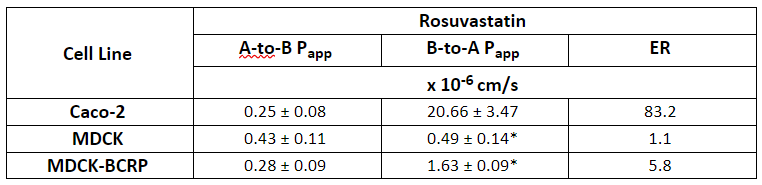
Rosuvastatin is one of the most widely prescribed statins and implicated in BCRP DDI’s due to its victim classification. Rosuvastatin is a polar compound with a logP of 0.13 and therefore has low permeability and is dependent upon uptake mechanisms to enter cells such as MDCK. The flux of rosuvastatin, apical to basolateral, basolateral to apical and the subsequent efflux ratios can be seen in Table 1 [Li et al. 2012] for three cell lines. The B-A secretory apparent permeability (and derived efflux ratio) is significantly higher (and therefore more sensitive) in Caco-2 cells compared to that in the two MDCK cell lines even though the protein expression of the BCRP transporter in Caco-2 cells would be considerably lower than in the transfected MDCK-BCRP cells, demonstrating the crucial requirement of the basolateral uptake mechanism that is present in Caco2, but absent in MDCK-BCRP, to facilitate the interaction of rosuvastatin with intracellular BCRP on the apical membrane.  This factor needs to be taken into consideration when it comes to assessing the efflux potential of an investigational drug using MDCK-BCRP cells. 

Table 1: Bidirectional (apical-to-basolateral (A-B) & basolateral-to-apical (B-A)) apparent permeability (Papp) and efflux ratios for rosuvastatin in different cell test systems [1]  
ImportantConsiderationsForChoosingTheInVitroCellTestSystem
*P<0.001, significance level of the difference from the B-to-A transport in Caco-2 

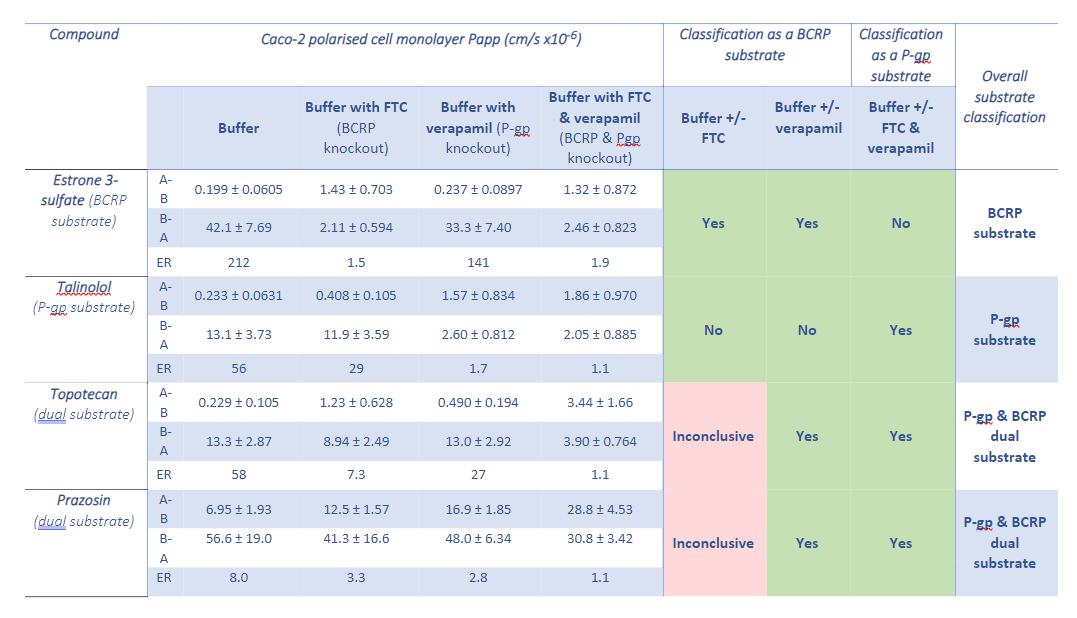
As shown the use of Caco-2 cells for BCRP substrate identification removes a complication seen in MDCK-BCRP cells that is dependent on the physicochemical properties of the compound, however Caco-2 cells come with their own complexities. As Caco-2 are human derived cells they express a range of endogenous human transporters including human P-glycoprotein (P-gp). BCRP and P-gp have a similar substrate profile and therefore the efflux seen in Caco-2 cells may be due to BCRP, Pgp efflux or a combination of both. In order to decipher between the two main efflux transporters a selective P-gp inhibitor such as verapamil can be added to the test system buffer to chemically knockdown P-gp activity. The residual efflux is then considered to be due to BCRP transport however this can be confirmed using a selective BCRP inhibitor, fumitremorgin C (FTC) as shown in Table 2. 
ImportantConsiderationsForChoosingTheInVitroCellTestSystemTable2
Table 2: Bidirectional (apical-to-basolateral (A-B) & basolateral-to-apical (B-A)) apparent permeability (Papp) and efflux ratios for test compounds and the substrate classifications given per assay condition 

Choosing the right in vitro cell test system for BCRP substrate identification is critical for achieving the correct classification. The two gold-standard approaches have their own pros and cons, each of which can be mitigated if these test system limitations are understood. If a chemical series has a reasonable degree of lipophilicity then MDCK-BCRP should correctly identify a substrate of BCRP. However, as the industry moves towards more metabolically stable molecules and chemical series that have similar low intrinsic permeability and polarity to the clinically relevant BCRP substrate rosuvastatin, the use of Caco-2 cells would be required for the correct identification of BCRP substrates in order to avoid false negatives.

References

  1. Birmingham BK, Bujac SR, Elsby R, et al. Impact of ABCG2 and SLCO1B1 polymorphisms on pharmacokinetics of rosuvastatin, atorvastatin and simvastatin acid in Caucasian and Asian subjects: a class effect? Eur J Clin Pharmacol. 2015 Mar;71(3):341-55.  
  2. Li J, Wang Y, Zhang W, Huang Y, Hein K, Hidalgo IJ. The role of a basolateral transporter in rosuvastatin transport and its interplay with apical breast cancer resistance protein in polarized cell monolayer systems. Drug Metab Dispos. 2012 Nov;40(11):2102-8.  
  3. Hua, W.J., Hua, W.X. and Fang, H.J, The Role of OATP1B1 and BCRP in Pharmacokinetics and DDI of Novel Statins. Cardiovascular Therapeutics,. 2012, 30: e234-e241. 

Tags: Blog, ADME/DMPK